
The Image Is Real. The Story Is Fake.
The pixels can be genuine. The caption can still lead you somewhere the evidence never went.
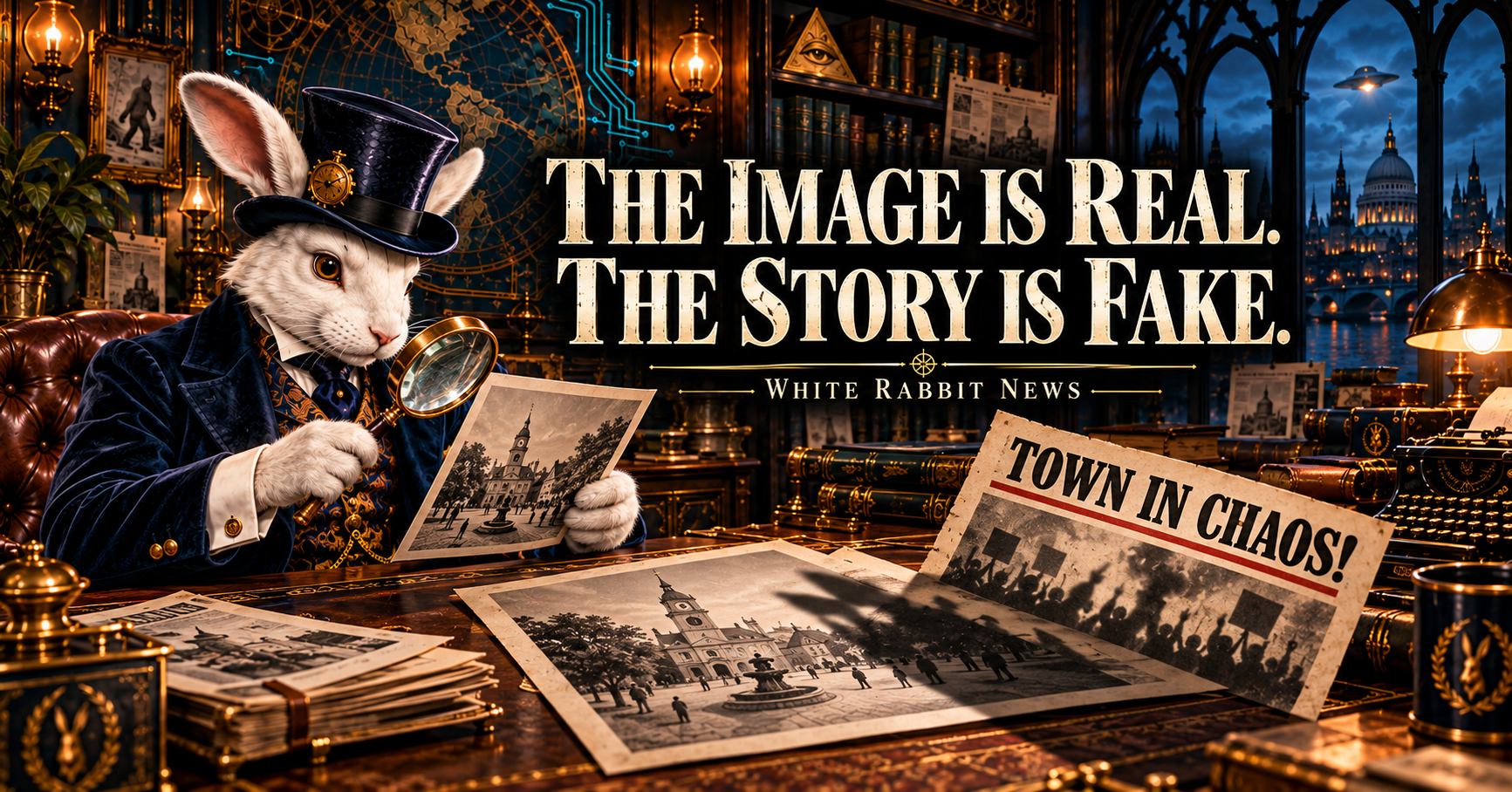
The photograph is sharp. The faces look natural. The shadows make sense. You study it for signs of artificial intelligence and find nothing suspicious.
Then you share it—with a story the photograph never proved.
That is the trap. An authentic picture can be paired with the wrong date, the wrong place, or an invented explanation. The camera may have recorded something real. The caption may be asking you to believe something else entirely.
The lie can live outside the photograph
Verification organization First Draft describes false context: genuine material presented with misleading surrounding information. Its guide distinguishes that from fabricated or digitally manipulated content. A picture does not need to be manufactured to become part of a false account. [1]
Consider the gap between what you can see and what you have been told. You can see a crowd. Can you establish what brought it together? You can see smoke. Can you establish what caused it? You can see someone standing beside another person. Does that establish agreement, friendship, or involvement in a crime?
Each extra assertion needs its own evidence. A vivid picture cannot quietly do the work of a missing source.
Four ways the frame changes
The following are hypothetical teaching examples, not reports of specific incidents.
| The material | The misleading frame | What to check |
|---|---|---|
| An old flood photograph | “This is happening here tonight.” | Earlier publications, location and the original date. |
| A crowd at a public celebration | “Thousands march against the new policy.” | Who recorded it, signs, event records and wider footage. |
| A tight crop of a heated encounter | “This proves who started it.” | The full frame and the sequence before and after. |
| A real video with a new voice-over | “Listen to what the people there are saying.” | An earlier recording and whether the audio belongs to it. |
A crop can remove information while preserving every visible pixel inside its boundaries. A short clip can preserve a real moment while omitting the explanation that came seconds earlier. These are reasons to look for the fuller record; they are not proof that every crop or edit is dishonest.
A photograph can show you what was inside the frame. It cannot, by itself, establish everything someone says happened outside it.
Before you share: follow five leads
1. Put the claim into one sentence
Write down exactly what the post is asserting: who, what, where and when. “A dramatic scene” is not the same claim as “this happened in our town this morning.” Identifying the claim tells you what needs checking.
2. Find the image’s earlier life
Use a reverse image search. On a computer, Google lets you upload a file or paste an image URL through its Search by image control. Lens can return matching or similar images and pages where they appear. Open those pages and examine the evidence; a search summary is only a lead. [2]
Google’s About this image, where available, can show earlier uses and when Google may have first encountered a similar version. That can help you spot a picture whose history predates the event claimed in a post. [3]
3. Read beyond the repost
Look for the photographer, original uploader, agency caption or fuller recording. Compare the stated place and date with visible details: signs, landmarks, weather and language. Treat those details as clues to corroborate, rather than permission to guess. Several accounts repeating the same caption are not necessarily several independent sources.
4. Search for the missing frame
Try a second search service and compare differently cropped versions. TinEye offers ways to find larger or changed copies, which may help recover a fuller view. A mismatch deserves investigation; it does not automatically establish who altered it or why. [4]
For video, pause at several distinctive moments and search screenshots. The InVID verification toolkit also provides keyframe extraction for supported material, allowing individual frames to become search leads. A match to an older clip can reveal a recycled scene. It still takes source checking to establish the correct story. [5]
5. Decide what you actually know
You may confirm the caption. You may contradict it. You may be unable to settle the question. “I cannot verify this” is an honest result. It is different from “this is fake,” and it is a good reason to hold off sharing a claim as established fact.
A search engine is a lead, not a verdict
TinEye’s “first found” date records when its crawler encountered a matching image—not when the photograph was taken, and not necessarily when it first appeared online. An older match can challenge a “taken today” claim without identifying the exact original date. [6]
No results do not authenticate a picture. The image may be new, unavailable to the search engine or different enough to escape a match; TinEye explains that its results are limited to its own index. [4]
Metadata deserves the same caution. Google notes that image credit and source-type metadata can be changed using editing tools, so it recommends corroborating those details. A tag is information to check, not a certificate of truth. [3]
Likewise, a verdict about whether an image was generated cannot establish the date, location or motive asserted in a caption. Even if the picture passes an authenticity check, the story still has work to do.
Already shared it? Leave a clearer trail
If you discover a mistake, make the correction easy to find. Say which part was wrong and link to the evidence that changed your mind. If the original claim is doing harm, remove it and consider a separate correction for people who already saw it.
A useful correction might read: “I shared this as footage from today’s event. The earlier source shows it was recorded elsewhere. The clip is real; the date and location I repeated were wrong.”
You do not have to defend a bad caption to prove you are a loyal friend, a good citizen or a member of the right group. Accuracy is worth more than protecting yesterday’s certainty.
The rabbit’s take
Be curious when a picture challenges your beliefs. Be just as curious when it flatters them. Follow the source far enough to learn whether the evidence belongs to the story.
Sources & further reading
- First Draft — Understanding Information Disorder — False context and distinctions between misleading, manipulated and fabricated content.
- Google Search Help — Search with an image — Image-upload and image-URL searches with Google Lens.
- Google Search Help — Learn more about an image — Earlier uses, approximate image history, availability and metadata limitations.
- TinEye — How to search for an image — Search options, changed copies and limits of the index.
- InVID project — Verification Plugin — Keyframes and image/video verification tools; platform support can change.
- TinEye — What “first found on” means — Crawler discovery dates are not capture dates.
Sources checked October 25, 2026. This is an evergreen media-literacy guide. Examples are hypothetical; the artwork is an AI-generated editorial illustration, not a photograph of an actual investigation.