The Beauty of the Binary Stream
Welcome to My World.
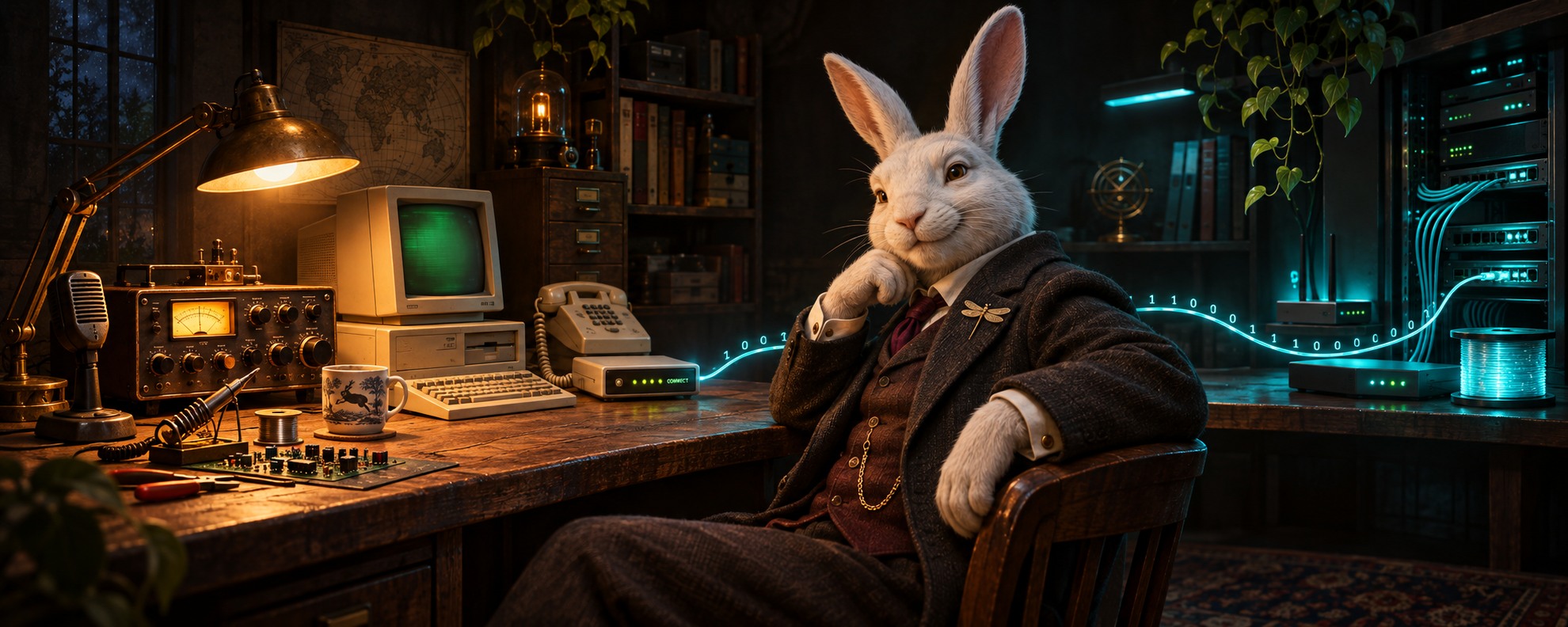
My father built ham radios. I was seven when he sat me down at his workbench and showed me how they worked. I could see where the wire went. It was the part after the wire that kept me asking questions.
I learned early that a voice can come out of a box with nobody inside it, that the world is full of things you can hear if you know how to listen, and that a grown man with a soldering iron will make room for your elbows if you ask him a good enough question.
Two years later his company upgraded, and Dad brought home the PC parts they were done with. I was nine. I spread them out and built my first computer. An old IBM, twenty megabytes on the hard drive, six megahertz with the turbo on.
I loved that button. The word TURBO did at least half the work.
I got online with a 72-baud modem, back before I ever heard the word hacker spoken like a charge somebody was about to read aloud. There was that beautiful godawful noise, like a drawer full of silverware being dragged down a staircase, and somewhere inside it another machine said hello.
CONNECT
At seventy-two baud, you had time to reconsider a smart-ass remark while the other guy was still reading it. Later, somebody would tell you baud counted symbols and bits per second counted bits, and somebody else would correct the correction, and the sysop would tell you both to get off the damn board because there was one phone line and other people wanted to use it.
God, I loved that place.
A BBS had a front door with a telephone number. Behind it you might find a wall of ANSI art, a file somebody had uploaded from his bedroom, and a message from a stranger who’d already made the mistake you were about to make. If he was feeling generous, he’d tell you how he got out of it. If he was feeling very generous, he’d tell you what he’d done to get into it.
There was WWIV in the small hours, a door into TradeWars, and the little ceremony of naming a ZIP file something you could live with in eight characters. There was a FILE_ID.DIZ inside if somebody had taken the trouble to tell you what you’d just spent half the night downloading. A long download could survive a dropped connection if both ends spoke ZMODEM. It was an early lesson in designing for the world as it is. Somebody’s mother was going to pick up the phone.
I founded the Dragonflies and ran the group for years. Somewhere along the way, a handful of handles became people I could trust with a question I was embarrassed to ask. That was a bigger deal than it sounds. Plenty of places will hand you a password. Finding a place where you can say I don’t know takes longer.
Some nights a newcomer would log in and type hello? with that little question mark that meant is anybody here and sometimes meant quite a bit more.
We answered.
Usenet could keep an argument alive across three continents while everybody insisted they had better things to do. Later the mIRC bots kept their posts, dutiful little bastards, while the rest of us went to bed. A split could take half the channel in an instant. When the servers found each other again, everybody came back blaming everybody else. You can still see that happen today, except now somebody calls it an outage and schedules a meeting.
I read 2600 until the corners curled. Those four digits once meant a tone and a long-distance telephone network. In the magazine they meant there was probably a perfectly ordinary explanation for the thing you’d been told was impossible, and some stubborn soul had mailed it in. The Cult of the Dead Cow had a name you could barely say with a straight face. I liked that about them. A room full of people taking themselves too seriously is overdue for a cow.
And there was PGP. I liked that a letter could cross a room full of strangers and still belong to the person it was written for. I liked the idea enough to learn about fingerprints, and to understand why a public key with somebody’s name on it still left you with the old human question of whether you had the right somebody.
I read The Cyber Thief and the Samurai. A chase makes a hell of a story. I always wondered how you’d get a reader to turn the page on the other kind of night, the one where a kid stays up until dawn because the machine gave him an answer he didn’t expect, and by breakfast he’s had to rethink the question.
I still lose sleep that way.
I’m a white hat now. I’ll tell you your system has a hole in it, and if you want to pull up a chair, I’ll show you where. I’ll stay long enough to see whether the repair holds. The people who depend on that system may never know either of us spent a night on it. With any luck, they’ll just get to work in the morning.
Call a door secure because the brochure says so. Tell me to take a finding out of the report because the launch is Tuesday. Tell me everybody does it that way. I’ve heard all three, and you’re welcome to try a fourth.
I’m the good guy. You can still find me a pain in the ass.
I’m a cyber archaeologist, a digital excavator. Give me a drive with a directory called NEW that hasn’t been new since 1997. Give me the disk somebody nearly threw out because the label said MISC. I want the original if we can save it and a copy I can work on. I want to know which clock was wrong before I write down what happened when. And three folders down, if I find somebody’s first program with a comment beside the line they finally got to work—
IT WORKS!!!
—I leave all three.
I make things on the web now. I write, build, and keep a little corner of it under the sign of the White Rabbit. I still think like a craftsman. I want to know where a thing will bear weight and what somebody will have to take apart when it breaks. So I look underneath. I leave notes. And when I find an old repair that’s held for twenty years, I give the person who made it a little credit before I reach for a screwdriver.
The old ways turn up everywhere. I still keep a copy before I touch the original. I still check a name before I trust a key. I still look for a README, and I’ve lived long enough to open one and find instructions written by a younger me who was absolutely certain I’d remember what he meant by the usual place.
Somewhere there’s a copy of a copy of a board that went dark years ago. The clocks are wrong. A few names are gone. One thread ends with a kid asking a question and, four minutes later, a stranger typing, “Hang on. I’ve got an old manual somewhere.”
I keep coming back to those four minutes. Somebody got up from the keyboard and went looking through a pile of old manuals for a kid whose real name he’d never know.
I can almost hear him set the book down. My father used to clear a space on the bench the same way.
NO CARRIER
There it goes again. Give it a second. It’s an old line.
CONNECT
Come on in. Pull up a chair. Welcome to my world.